
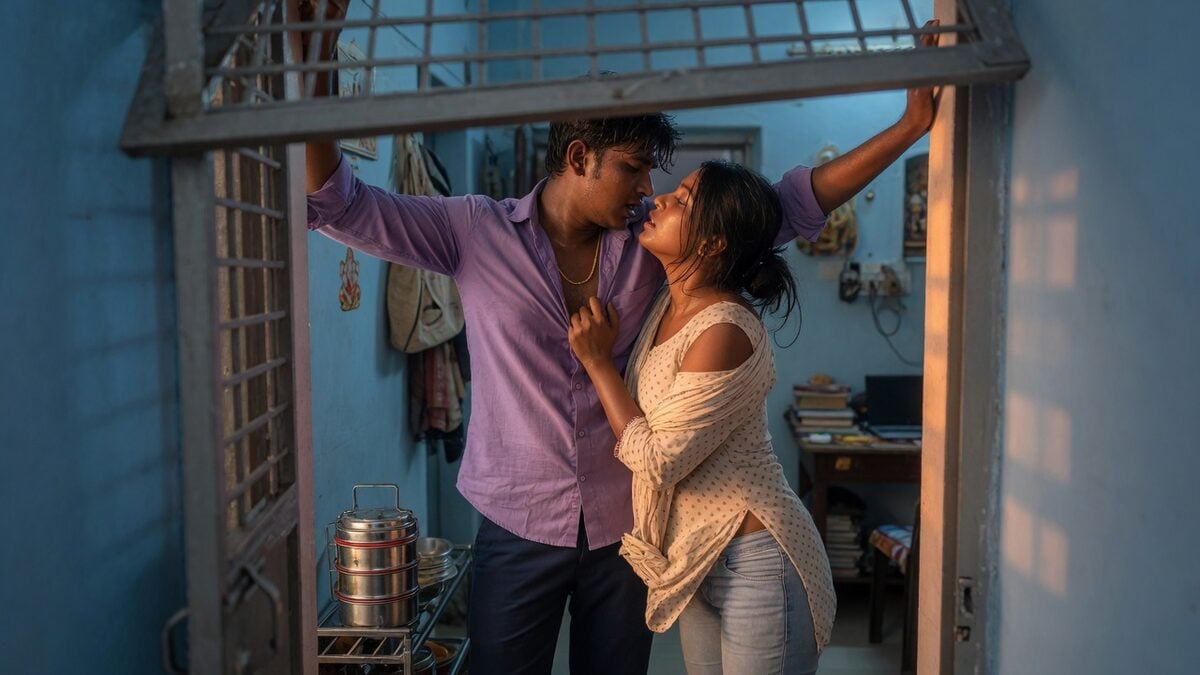
Malini’s needle slipped through the third marigold and caught my thumb.
“Sorry,” she said, but she did not pull her hand back. Orange dye stained both of us. The ceiling fan in the Lakeside Residency community hall clicked on its loose bearing, and the heap of jasmine between our knees kept giving off that sweet, almost funeral smell.
We were the last two on cultural committee duty. Four extra garlands had to be ready before nine for the society Ganesh pandal. Everyone else had gone downstairs for dinner, taking their gossip and their steel tiffin boxes with them.
Hyderabad held the day’s heat even after sunset. The tube lights made the petals look slightly waxed. My olive kurta already showed water spots from the stems. Malini’s yellow salwar had a wet patch near the knee where a jasmine bunch had leaked.
In India, a women’s committee still treats two unmarried neighbors like a public project. Mrs. Reddy had told me twice that Malini was spoken for, that a man in Bengaluru would come in December, and that I should keep a decent gap on the folding chairs.
The gap had held for three Sundays. Tonight Malini had dragged her chair until our knees touched. She threaded fast, then slow, then not at all. Her phone lay face up on the table, screen dark, until a message flashed and the lock screen lit the steel thali.
Two women stood under Charminar in the photo, laughing, shoulders pressed together. No man. No Bengaluru skyline. Just a Hyderabad monument and a closeness Mrs. Reddy would have called improper.
Malini saw me looking. She reached for the phone, then stopped, as if grabbing it would confess more than the picture already had.
“You told Mrs. Reddy you have a man in Bengaluru,” I said. “Why is your lock screen two women at Charminar?”
We Stopped Stringing Marigolds
The fan kept clicking. A scooter passed on the inner road. Malini set the needle down on the thali as if it might break.
“There is no man,” she said. “There never was. I said it so they would stop pairing me with every cousin who visits from Secunderabad.”
“And the photo?”
“College. She left the city. I kept the picture because I liked how I looked when I was allowed to stand that close to another woman.”
Going back to the marigolds would have been the sensible thing. The committee would measure our work by length, not by honesty. The first answer had already wrecked the polite version of the evening, so the next question came out anyway.
“Why sit this close tonight, then? You told them you hate being touched.”
Malini laughed once, a dry sound. “I hate being touched by people who are checking me for a wedding market. I do not hate this.”
Her knee pressed mine more firmly. The jasmine between us slid. My pulse sat high in my throat, stupid and obvious.
“This meaning my knee?” I asked.
“This meaning you, Ishita. Don’t make me say it in a hall with a glass door.”
The courtyard beyond that glass was empty except for a parked scooter and the outline of pandal bamboo. The rest of India could keep its polite stories about good girls and distant fiances. In this hall the story had already changed.
Malini stood first. Thread still clung to her fingers. She wiped it on her salwar, then held out the same hand, not as a committee instruction, just as an offer. I took it. The chair legs scraped. We ended up between the table and the stacked dhurries at the back wall, where the tube light did not reach as hard.
“If you want to keep stringing flowers, say so,” she murmured.
“I don’t.”
That was the whole permission we needed. Her mouth found mine without a speech. She tasted like the elaichi Mrs. Reddy had forced on everyone at five. My hands went to her waist because the yellow kameez had been driving me mad since June and there was finally no auntie counting the inches between us.
The kiss turned hungry in a way committee work never did. Malini’s dupatta slid off one shoulder. I caught it, then let it drop to the dhurrie because holding cloth felt like pretending we were still decent. She made a small sound into my mouth when my palm crossed the cotton over her breast.
“Yes,” she said against my teeth. “Now.”
We went down on the stacked rugs because standing made the glass door feel like an audience. The hall still smelled of stems and metal. Malini pulled my olive kurta up and I lifted my arms. The churidar stayed for another minute, then did not. Her hands were cooler than the Hyderabad night, and they shook once when they found bare skin.
“You have been looking,” she said.
“For months.”
“Same.”
Nothing Left to Pretend
The yellow kameez came off next. Under it she wore a plain beige bra that had no business looking that intimate. I unhooked it because asking again would have turned the moment into a lecture, and she arched to help. Her breasts were heavier than the committee gossip had any right to imagine. I put my mouth on her, and she grabbed the back of my head hard enough to mean it.
Jasmine petals stuck to her salwar when I dragged the rest down. She kicked the cloth free and pulled me over her, skin to skin, the dhurrie scratching my knees. We were two adult women in a locked-looking hall that was not actually locked, and the risk of that sat under the wanting like a second pulse.
Malini rolled me. Her thigh pushed between mine, and the friction was so immediate I made a noise I would never have made near Mrs. Reddy’s steel tiffin. She smiled like she had been waiting to hear it. Her fingers slid down, found me wet, and stayed there with a patience the garlands had never received.
“Tell me if the pace is wrong,” she said once, and then she listened with her hand instead of more talk.
It was not wrong. She rubbed in slow circles, then firmer, two fingers slipping inside when my hips asked without language. I held her wrist and moved with her. The fan clicked. Somewhere a pressure cooker whistled in a downstairs kitchen, ordinary India continuing while we wrecked the version of ourselves the committee preferred.
When I came the first time it was against her palm, face in her shoulder, olive kurta still half under my back. Malini kissed the corner of my mouth as if she were sealing something. I needed a few breaths. Then I needed her the way she had needed the lie about Bengaluru: completely, and without an audience.
I kissed down her stomach. She opened her knees without being arranged like a diagram. The taste of her was salt and heat and crushed flower. I used my mouth the way I had thought about on those three Sundays of decent gaps, slow at first, then greedier when her hand fisted in my hair. Her hips lifted. A chair behind us ticked as if the empty hall had opinions.
“Ishita,” she said, not loud, but broken enough that I did not stop.
Two fingers joined my tongue because she was pushing into me and I wanted her to have nowhere left to hide. Malini came with her heel digging into the dhurrie and her other hand over her own mouth, committee training still trying to keep a woman quiet. I stayed until the shaking eased, then crawled up and let her taste herself on my mouth.
We did not invent a second choreography. She pulled my thigh over hers and we ground together, wet, clumsy, laughing once when a marigold rolled off the table and hit the floor like a tiny accusation. That laugh turned into another kiss. Her hand slipped back between us. Mine did too. We finished that way, forehead to forehead, the tube light buzzing as if it were embarrassed for Hyderabad.
For a minute the only work left in the hall was breathing. Malini’s hair had come out of its clip. Petals stuck to my hip. The unfinished garlands looked suddenly childish, orange and white ropes for a god who had not asked two neighbors to lie about men in Bengaluru.
“They will notice the length,” she said, meaning the flowers.
“They notice everything except what is in front of them.”
She traced the dye on my thumb, the same stain from the start of the evening. No speech about later. No inventory of what we had done. Just that small, stunned quiet that follows a choice you cannot put back on a folding chair.
The Courtyard Called Us Out
A man’s voice hit the glass from below, flattened by the courtyard echo.
“Madam! Electrician is here. Hall lights off in ten minutes. Pandal line is waiting.”
Malini sat up so fast her shoulder bumped my chin. We grabbed cloth in the wrong order. My churidar went on inside out, then had to be fixed. Her beige bra tangled with the dupatta. The yellow kameez stuck to her back because we were still damp. I found the olive kurta under a jasmine heap and pulled it on without shaking the flowers off, which left me looking like I had lost a fight with the pandal.
“Dupatta,” I said.
She flung it around her neck. One end hung longer. The wrong side faced out, the cheaper weave showing. There was no time to make it committee-perfect. We shoved the dhurries back into a stack that no longer looked unused. The steel thali still held thread and a wreck of stems.
The watchman, Harish, was already at the open doorway with the electrician behind him, a coil of wire over one shoulder. Harish took in the crushed marigolds, the reversed dupatta, my hair, the fact that two women who were supposed to be producing garlands had produced very little string and a lot of rumpled cotton.
“Work not finished?” he asked, not unkind, but not blind.
“Heat,” Malini said. “We will take the rest down.”
We carried the unfinished garlands into the courtyard because the hall lights died behind us on the electrician’s first pull. Bamboo ribs of the pandal stood half-dressed in the dark. Mrs. Reddy’s voice floated from a balcony, asking whether the extra strings were ready. Neither of us answered. Malini walked with her dupatta still reversed, and I walked with orange dye on my mouth that was not from any flower I could blame.
Harish switched on the courtyard bulb. It caught us anyway. The electrician muttered about fuses. Across the inner road a scooter started, ordinary, loud, uninterested in what two women lovers had done with an empty society hall.
Malini’s hand brushed mine once around the stems, hidden by marigolds, and then she let go because the balcony above us had ears. The garlands would be short tomorrow. That was the part the committee would measure. The rest of it stayed on our skin, in the dye, in the reversed cloth she did not stop to fix even after we reached the stairwell.