
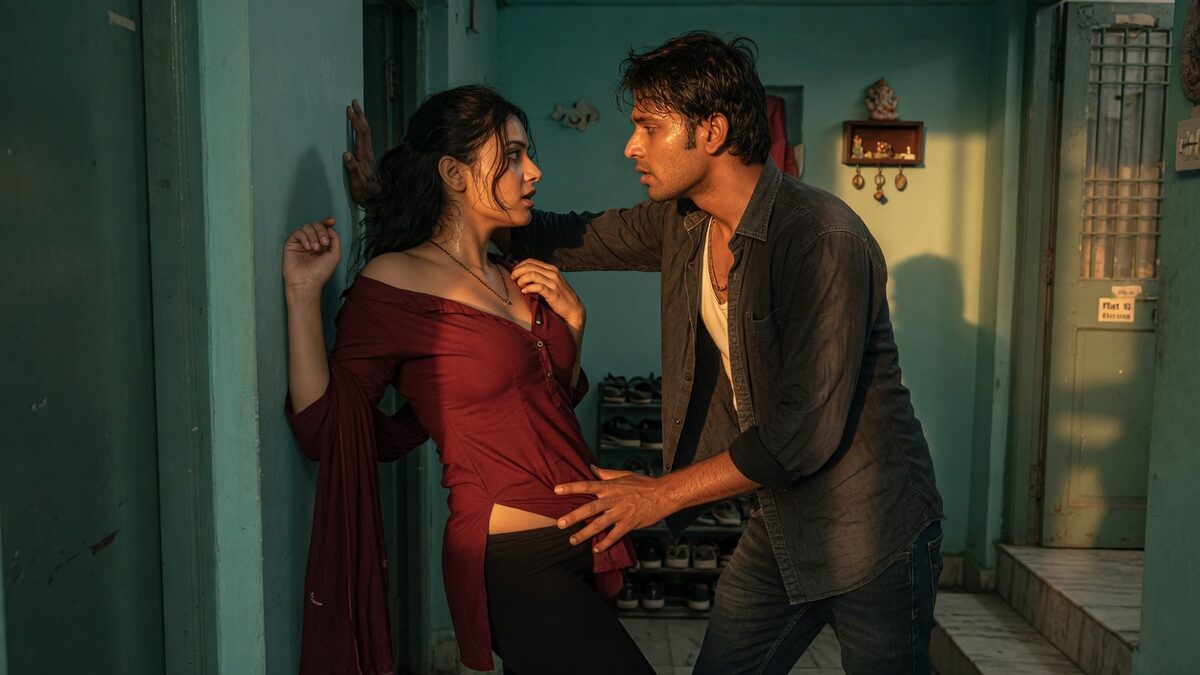
“Stop sending more biodatas, Ma. I already told Mrs. Gupta they can come on Sunday.”
Malini’s voice came through the half-open kitchen door of her independent floor in Chandigarh, and the steel box of leftover laddoos suddenly felt heavy in my hands. The engagement downstairs had ended an hour earlier. Her aunt had pressed the box on me and pointed up the stairs as if I still belonged in this house.
She had not seen me yet. The cream kameez still held the smell of incense. Her maroon dupatta had slipped off one shoulder and hung from the crook of her elbow. Families across north India treat a Sunday visit like a signature, and she had already given hers in a single sentence.
I stepped into the kitchen anyway. The tap was running over a pile of steel bowls. Malini turned, phone still at her ear, and the colour left her face in one ugly drop.
“Tejas is here, Ma. I’ll call you back.” She cut the line without waiting for an answer.
“You already said yes.” The words came out flatter than I meant. “To the Guptas.”
Malini set the phone face down beside the sink. Water kept running. “You were not supposed to be upstairs.”
“Your aunt sent the laddoos. I heard the rest.”
She shut the tap with more force than the handle needed. For three years after college we had done this dance in Chandigarh parks and on this same floor, never naming it, never stopping it. Last month, after her cousin’s sangeet practice, I had kissed her against the fridge and she had kissed back, then pushed me toward the stairs because her father was parking the car.
“You could have told me,” I said.
“Told you what? That my mother has been forwarding photographs since Diwali? That I got tired of waiting for you to say a sentence that was not a joke?” Her voice stayed low because the family was still somewhere below us, collecting gift envelopes. “I said Sunday because saying no again would have started a war in this house.”
“So you volunteered me out of your week.”
Malini laughed once, without humour. “You don’t live here, Tejas. You come when there is a function and you leave with a steel box. I am thirty. In this part of India a cancelled Sunday can travel faster than a wedding card, and I still chose the easier lie.”
What she had already told them
The living room light was the warm yellow of a cheap chandelier. Cushions from the engagement still sat in a crooked pile on the sofa. Malini walked past me, dropped the dupatta on a chair, and stood with her back to the window that faced the inner courtyard.
“Mrs. Gupta’s son is in IT in Gurugram,” she said. “He is thirty-two. My mother likes his salary. I have not even seen a recent photo. I said they can come because I wanted the noise to stop for five days.”
“And after five days?”
“I would have sat through tea and found a fault. Too tall. Too quiet. Too fond of his mother. The usual theatre.” She looked at me properly then. “Don’t stand there like I cheated on a husband. We were never that.”
The steel box went onto the dining table with a dull sound. My jacket stayed on because taking it off felt like claiming the room. Anger sat in my throat beside something older, the same pull that had made me climb these stairs instead of going home to my rented room near Sector 22.
Malini’s mouth tightened. “If you came up to scold me, finish it and go. If you came up because that kiss last month is still sitting in your chest, then say that instead of performing shock.”
“Both,” I said. “I am angry you decided Sunday without me in the sentence. I am also not leaving with the laddoos.”
She crossed the rug. Close enough that the incense in her kameez mixed with the leftover sweets. “Then don’t leave. I am not going to the Guptas with your mouth still on my mind. That is my problem, not a proposal.”
My hand found her waist over the cotton. She did not step back. The courtyard below still held voices, someone laughing about a misplaced envelope, and the distance of one floor was the only privacy we were going to get.
“Malini.”
“If you ask whether I am sure, I will throw the box at you.” She took my other hand and put it on the hook of her kameez at the side. “I want this tonight. Not as a protest against Sunday. Because I have wanted you since the sangeet practice and I am done pretending the rishta talk erases that.”
That was the whole permission I needed. I kissed her the way I had against the fridge, except this time nobody’s car was pulling in. Her mouth opened at once. The maroon dupatta slid from the chair to the floor when we bumped it. She pulled my shirt from my trousers without grace, buttons fighting her, and I got the side hook of the kameez open and the inner ties after that.
Cream cloth bunched at her hips. A plain beige bra, the kind worn for a long family function, not for display. I kissed the line above it and she made a sound she immediately tried to swallow, then stopped trying. Her fingers were already at my belt.
The sofa stopped being for guests
We did not make it to the bedroom. The sofa took us because it was closer and the pile of cushions made a ridiculous backrest. Malini sat first, pulled me down by the open shirt, and I got my mouth on her throat while she undid my trousers far enough to get her hand inside.
She was already wet when I slid my palm up under the salwar, past the elastic, against cotton underwear that had no business feeling that hot. Two fingers along her, then under the cloth. Her hips lifted. The chandelier threw ugly shadows and I did not care.
“Slow is for people who have the house empty till morning,” she whispered, and bit my lower lip. “Do not get noble now.”
The salwar came down to her knees, then off one leg so she could open. Underwear followed. I shoved my trousers and shorts down just enough. She reached aside to the low table, yanked the drawer, and slapped a condom into my hand as if she had known the drawer would be part of this argument. The foil was not dusty. That fact landed and then left, because her other hand was already rolling it on me with impatient strokes.
I pushed into her in one long press that made both of us stop breathing. Tight, wet, no performance. Malini’s head went back against a borrowed cushion with a gold border. Her nails found my shoulder through the shirt I still had not fully removed.
The first thrusts were clumsy because the sofa was too short and her remaining salwar leg kept catching. She laughed into my mouth, then swore, then locked her ankles behind me as well as the angle allowed. Heat built without poetry. The wet sound of it filled the room under the distant courtyard noise.
“Harder,” she said, not as a line from a film, just as instruction. I gave her that, gripping the back of the sofa so we would not slide onto the rug. Each push drew a broken noise from her that she tried, and failed, to keep downstairs-safe.
Her kameez was open, bra shoved under her breasts. I sucked one nipple and she clenched around me so sharply I had to freeze or finish. Sweat collected at her hairline where the function makeup had already begun to fail. Chandigarh winter sat outside the glass, useless against this.
When the sofa became impossible, we went to the rug. Cushions fell with us. Malini ended up on her elbows, cream kameez still hanging off her arms, and I took her from behind with one hand on her hip and the other in her hair, not pulling hard, just holding. She pushed back onto me with a rhythm that had nothing left of the careful daughter who had said Sunday into a phone.
“Tejas.” My name, bitten off. “Don’t you dare stop.”
I reached around and rubbed her where she was slickest. Her arms shook. She came first, sudden, a full-body lock that dragged a groan out of me I could not swallow. I followed a few thrusts later, buried deep, forehead against her shoulder blade, the condom doing the unglamorous work while my mind went white.
We stayed like that until our breathing stopped sounding like a fight. The courtyard had gone quieter. Someone downstairs called for the driver. Malini’s elbow slid on the rug and she hissed, not from pleasure, from a carpet burn she would have to hide.
I pulled out carefully. The condom went into a tissue from the same low table, knotted, set aside. She rolled onto her back, kameez open, salwar still tangled around one ankle like a joke the evening had told on us.
She dialled before I reached my jacket
Malini sat up first. She pulled the salwar back on without looking for dignity, hooked the kameez closed enough to be a person again, and picked the phone up from the kitchen counter where she had left it. The screen lit her face. No speech about what we had been to each other. No inventory of the cushions.
“Ma,” she said when the call connected, voice even. “Listen before you start. Sunday is cancelled. Tell Mrs. Gupta not to come. I am not sitting for tea. I will explain tomorrow if you want a scene. Tonight I am not doing it.”
A tinny protest leaked from the speaker. Malini waited it out with her free hand in her hair.
“I said no. The visit is off.” She ended it. The phone went face down again, same as before, except this time the decision sat in the room with the steel box and my open shirt.
I had my trousers up and my belt done. The jacket still hung on the chair. Malini looked at it, then at me, and did not tell me to put it on.
“If you walk out with that box now, I will not stop you,” she said. “If you stay, you stay as the man who heard the yes and still came into the kitchen. Not as a secret I keep next to a biodata.”
The courtyard gate clanged once, a late relative leaving. I left the jacket where it was, crossed the rug, and took the steel box off the dining table only to set it on the kitchen counter, out of the way, as if the evening had a use for the table that did not involve leftovers.
Malini watched that small move. Then she reached past me, flicked the passage light off so the stairs would look dark from below, and took my wrist.
“Good,” she said. “Then we are not performing shock anymore.”